All Change!
The story of Penzance Railway Station 1852 - 1939
This Penwith Paper is based on slideshow that formed part of a presentation given by the Penwith Local History Group at Penzance Literary Festival, July 2023
On August 26th 1852, the West Cornwall Railway opened its line between Penzance and Truro – and with it a station at Penzance, where the travelling public would reach the seafront terminus. The town was fully decorated for the occasion, with arches over the main thoroughfares and houses, and shops decked out with greenery. Mayor Richard Pearce and various other VIPs had made an early start for Truro – and by midday the town was ready for their ceremonial return.
The railway had actually been operating out of the station building since March, providing passenger and goods trains as far as Redruth, but the official celebration was put off until the line through to Truro was completed. Everyone who lived within the Borough could now board within 20 minutes’ walk of their homes, and arrive in Truro less than two hours later. But more important was the speedy carriage of perishable produce – and quicker communication by means of letter post and newspapers. The passenger traffic was just a welcome extra. Hence the importance of the site – adjacent to Albert Pier, where cargoes could be transferred from ship to shore to railway train.
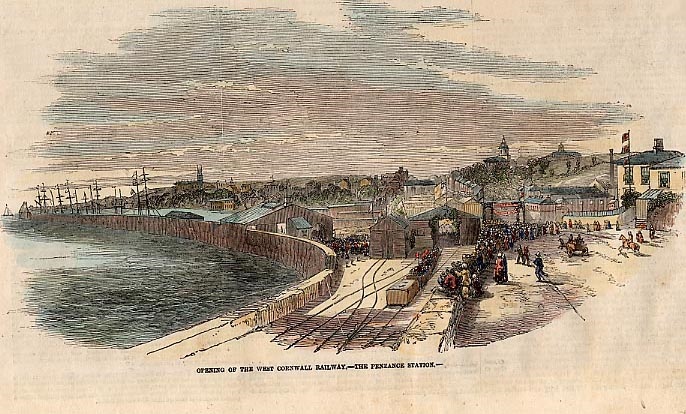
26th August 1852 - the opening of the West Cornwall Railway
By kind permission of Penlee House Gallery & Museum, Penzance PEZPH : 1996.272
The station is immediately recognisable in a drawing of that wonderful event in 1852 – but mainly because of the stone wall curving round into what is now the station car park and bus station, but was in 1852 the site of a goods shed at the bottom of Albert Pier. Next to it can be seen a small engine shed, with rails running straight into it. What seems to be a uniformed military band is waiting eagerly to perform. Crowds have gathered to peer over the wall and watch the train chuffing into town, and at the bottom of Market Jew Street the arch spanning the road outside the Railway Hotel (now the Longboat) is identifiable although not the words it displayed: ‘Welcome, one and all,’ ‘Victory’ and ‘Fish, Tin and Copper.’ The arriving train – with open carriages packed with passengers, a few flags and a covered (perhaps first class) carriage behind - is moving towards a large, open wooden building. This is to serve for the next 25 years as Penzance’s railway station.
But observant readers who know the town will have noticed something odd about the positioning of the buildings and the crowd of well-wishers, in relation to both Albert Pier and the bottom of Market Jew Street. The first Penzance railway station was in fact positioned 100 yards or so further east than its present-day counterpart.
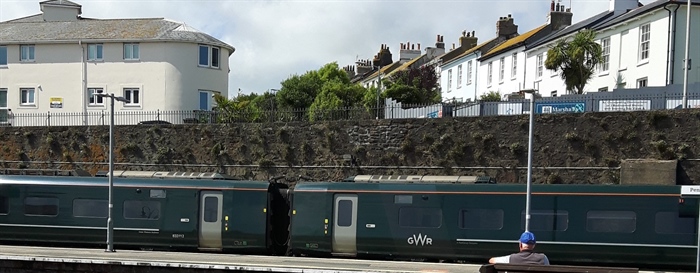
The approximate site of the first station
If you’ve ever noticed the bricked-up arch adjacent to platform 1, that is approximately where, if you were a passenger in 1852, you would have begun or ended your journey. And if you’ve ever wondered what was behind the bricks… apparently, not an underground road, culvert or even a smuggler’s hideaway: nothing but a coal store.
There is some reason to suppose that the fountain currently in St Anthony Gardens was commissioned to commemorate that Big Day in 1852.[i]
Whether or not that is true, there was certainly plenty of celebration laid on after the dignitaries stepped down onto the platform. They were greeted by a civic procession, which had made its way down Market Jew Street and through the goods shed, which allowed it to turn smoothly round so that it formed up in the correct order for the return journey up the hill. Those involved had plenty of time to admire their surroundings: the incoming train was an hour later than expected. By the time they arrived, the morning showers had cleared away, and the afternoon was sunny.
Later, there were speeches at the Market House, a Big Dinner for 80 at the Three Tuns Hotel, and beer, beef and plum pudding on the promenade for 500 – followed by a tea for the children of the town. In the evening the celebration continued, with fireworks on Albert Pier – although the Big Dinner went on so long that an intended Ball had to be postponed.
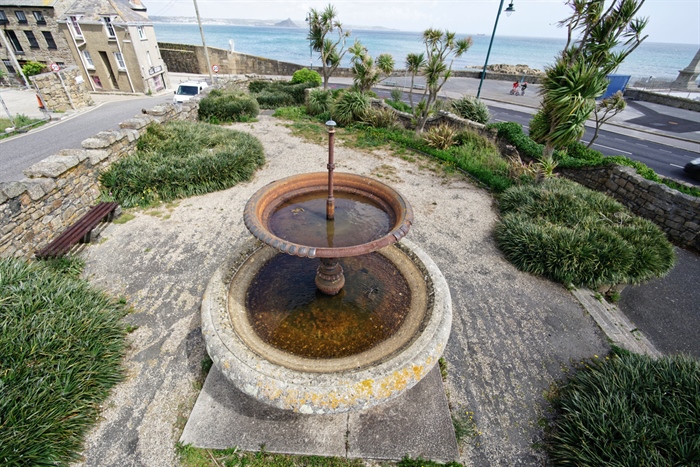
Was this fountain commissioned to commemorate the opening of the railway?
photo Kev Camidge
The next big event in the history of the railway was the opening of the Royal Albert Bridge on 2nd May 1859 – and once again, Penzance station had a part to play. A special train departed for Saltash at 6.10 am, carrying directors and officers of the West Cornwall Railway – and Richard Pearce, who had been elected mayor once again the previous autumn. They were hoping to meet Prince Albert on Cornish soil but unfortunately, their train was delayed by a mechanical problem. By the time a replacement engine had brought them to Saltash, it was too late: the Prince had already gone back to Plymouth for lunch.
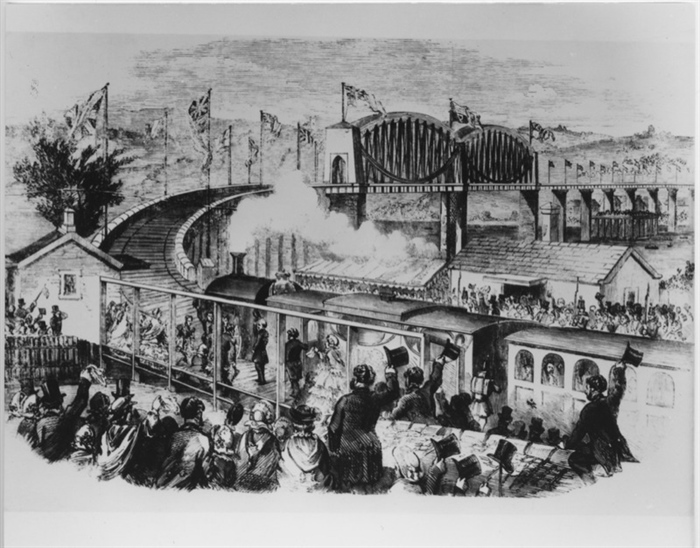
Opening of the Royal Albert Bridge, Saltash
“Drawing of opening of Royal Albert Bridge,” Morrab Library Photographic Archive, accessed August 21, 2023, https://photoarchive.morrablibrary.org.uk/items/show/7960. Reproduced by kind permission
But although the day had not gone entirely plan, Richard Pearce and the other dignitaries could be confident that they would be on surer ground once they got back to Penzance. When their train from Truro pulled in at 5.30 pm, there was an official party to greet them and crowds of bystanders to cheer their return. The shops had closed at what was then the exceptionally early time of 4.00; flags were flying and the whole town had what was described in the press as a ‘holiday aspect.’[ii] The train drew in, heralded by ‘the engineer’s shrill whistle.’ The Penzance Amateur Band played See the Conquering Hero Comes and the procession - which included dock workers and artisans – made its way up to the Market House for the usual range of dinners and other entertainments.
It was now possible to travel from Penzance to Plymouth, Bristol or even London without even changing stations - although until 1867 passengers would still need to change trains at Truro. This was because the line from Penzance to Truro only used the West Cornwall Railway’s narrow gauge rails, and the rest of the journey would be on the broad gauge used by the Great Western and its associates. Nevertheless, by leaving Penzance at 6.25 am a traveller could arrive at Exeter just before 1.00 pm, enjoy a leisurely lunch, board the train home at 3.00 pm and expect to be back in Penzance at 9.21 pm.
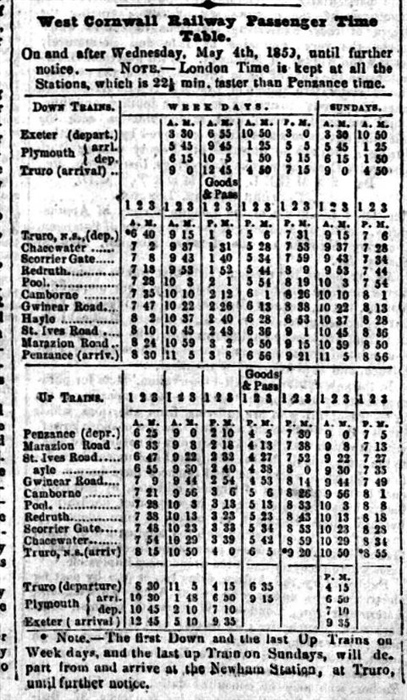
The railway timetable effective from 4th May 1859
Cornish Telegraph 4 5 1859 page 2 © British Library Board reproduced by kind permission
The wooden building that housed the terminus, however, did not please everyone. Five years after the celebrated opening of the Royal Albert Bridge, passengers who had made the 255 mile journey from London arrived to find the place in darkness, hardly able to distinguish their own luggage, let alone get down safely onto the single platform.[iii] And that could certainly be an issue – in 1870 the Queen of the Netherlands herself was said to have had a ‘narrow escape’ from falling flat on her face when she stepped down from the train.[iv] The station was ‘often unapproachable from carts, empty and laden, and the station crowded with empty baskets redolent of fish.’ Noisy blasts on the whistle, used to summon assistance to the turntable, frightened passing horses.[v] Engines shunting busily up and down only added to the disorder. ‘Altogether,’ a letter to the Western Morning News concluded, ‘I think our station the dirtiest, most disgraceful, and dangerous with which I am acquainted.’[vi]
The wooden goods shed burnt down in 1876, and in the same year the Great Western Railway took over the local companies which had successively owned the West Cornwall network since 1852. Between them, these two events provided the impetus for redevelopment. The goods and engine sheds were now combined in a single building and the passenger station was moved forward into what had previously been a stone yard. At the same time the Branwell’s Mill ‘island’ – currently occupied by Premier Inn and Mill Auto Supplies – was built. The gauge was now standardised, allowing for through trains. Penzance station was ready for the 20th century… and for the Cornish Riviera Express.
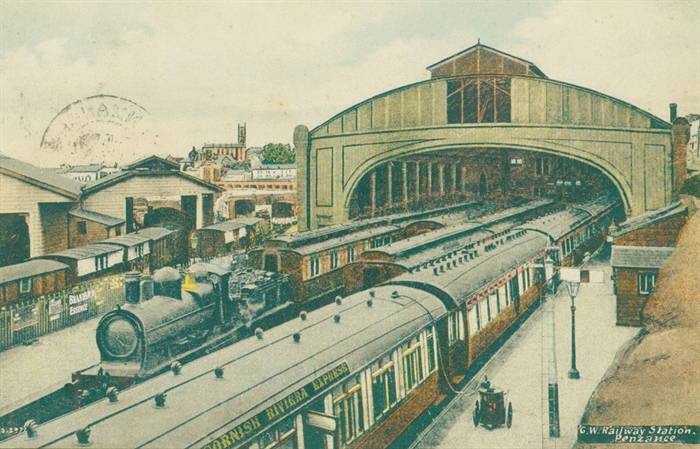
The Cornish Riviera about to depart in about 1900. Note the new engine and goods shed on the left
By kind permission of Penlee House Gallery & Museum, Penzance PEZPH : 1992.1173
Stanhope Forbes’ painting ‘Terminus’ showing what was then the departure platform was exhibited in 1925. By that time, the viaduct over the beach had been replaced by a solid embankment. Forbes painted from life, and had chosen a viewpoint on the balcony.[vii] Although those of us who remember the days of steam engines might consider that everything in the painting looks rather clean, all the fixtures of a 20th century railway station are in place: a magazine stall, a helpful porter with a handcart, uniformed staff – including one with a polished watchchain and buttons, who seems to be holding red and green flags. Families are gathering, ready to clamber on board the GWR coaches with their distinctive livery of chocolate and cream.
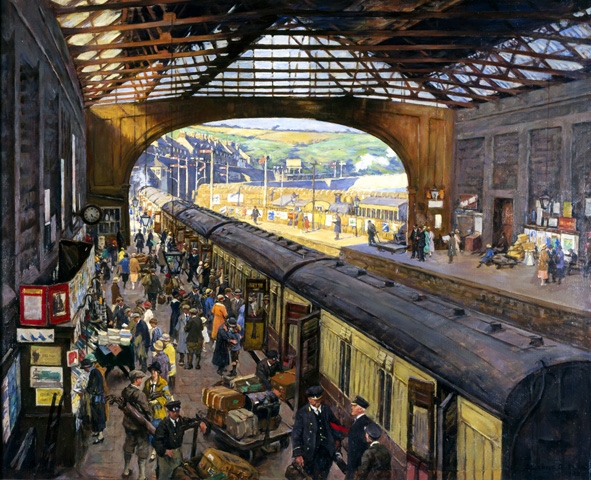
Stanhope Forbes ‘Terminus’ 1925
Reproduced by kind permission of the Science Museum Group. The Terminus (Penzance Station). Science Museum Group Collection Online. Accessed 15 August 2023.
If Forbes came back today, and managed to overcome his surprise at the loss of that convenient access down the staircase from the street, he would notice another change: the departure platform he painted no longer exists. In 1937, the station expanded onto reclaimed land – allowing for the layout and impressively long platforms that can still be seen today. The station was a major employer: 78 people worked there in 1938. With the capacity to handle any number of passengers, while the freight handling would be undertaken at Long Rock, Penzance railway station was a key element in the prosperity of the town, and all set for a glorious future.
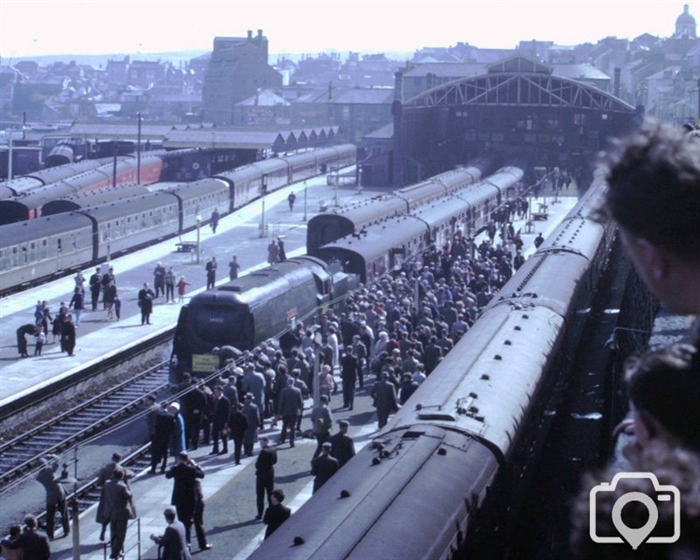
Penzance Railway Station 1960s
http://www.picturepenzance.com/media/penzance-railway-station-1960s.35732/full – it has not been possible to trace a copyright owner for this image
Linda Camidge August 2023
References:
A History of the Town and Borough of Penzance P A S Pool 1974 pp 10-153 and list on mayors p 282
Cornwall Railway Stations Mike Oakley 2009 pp 92-95
Stanhope Forbes’ The Terminus may be enjoyed at the National Railway Museum, York
The newspapers referenced in the endnotes are available at Kresen Kernow and on the BNA website
[i] See for example ‘Penzance Town Council’ Cornish Telegraph 27 4 1853 p 3 col 1 and 4 5 1853 p 3, letter signed ‘Looker-On’ Cornish Telegraph 4 5 1853 p 3
[ii] ‘Opening of the Royal Albert Bridge’ and ‘Proceedings at Penzance’ Cornish Telegraph 4 5 1859 p 2
[iii] ‘Correspondence’ - ‘The Railway Station’ Cornish Telegraph 13 7 1864 p 2
[iv] ‘Penzance Town Council’ – ‘The Penzance Railway Station’ Cornish Telegraph 16 3 1870 p 3
[v] ‘Penzance Town Council and Urban Sanitary Authority’ – ‘Dangers of Railway Whistling’ Cornish Telegraph 18 9 1877 p 4 and several other comments from autumn 1877 eg 2 10 p 4, 16 10 p 4, 20 11 1877 p 4
[vi] Letter reprinted as ‘The Penzance Railway Fish and Passenger Shed’ Cornish Telegraph 6 6 1876 p 2
[vii] ‘Newlyn Art Gallery’ Cornishman 17 9 1924 p 5
Penwith Local History Group
Edited by
Sally Corbet
price £10
plus p&p